The Man Behind the Myth
Robert Leroy Johnson was born in Hazlehurst, Mississippi in 1911. Details about his early life are sketchy — blues history from that era often is — but what we know is that he was obsessed with the guitar from a young age and determined to master it. By his late teens he was playing the Mississippi Delta juke joint circuit, learning from older players like Son House and Willie Brown.
By all accounts, the young Johnson wasn't particularly impressive at first. Son House himself reportedly found the kid more annoying than talented, recalling how Johnson would pick up his guitar during breaks and make a racket nobody wanted to hear.
Then something changed.
Johnson disappeared for a stretch — some say six months, some say longer — and when he came back, he could play like nobody had ever heard. His technique was startling. His voice was raw and haunting. He seemed to have arrived at a level of mastery that should have taken decades.
That gap in the timeline is where the legend was born.
The Devil at the Crossroads
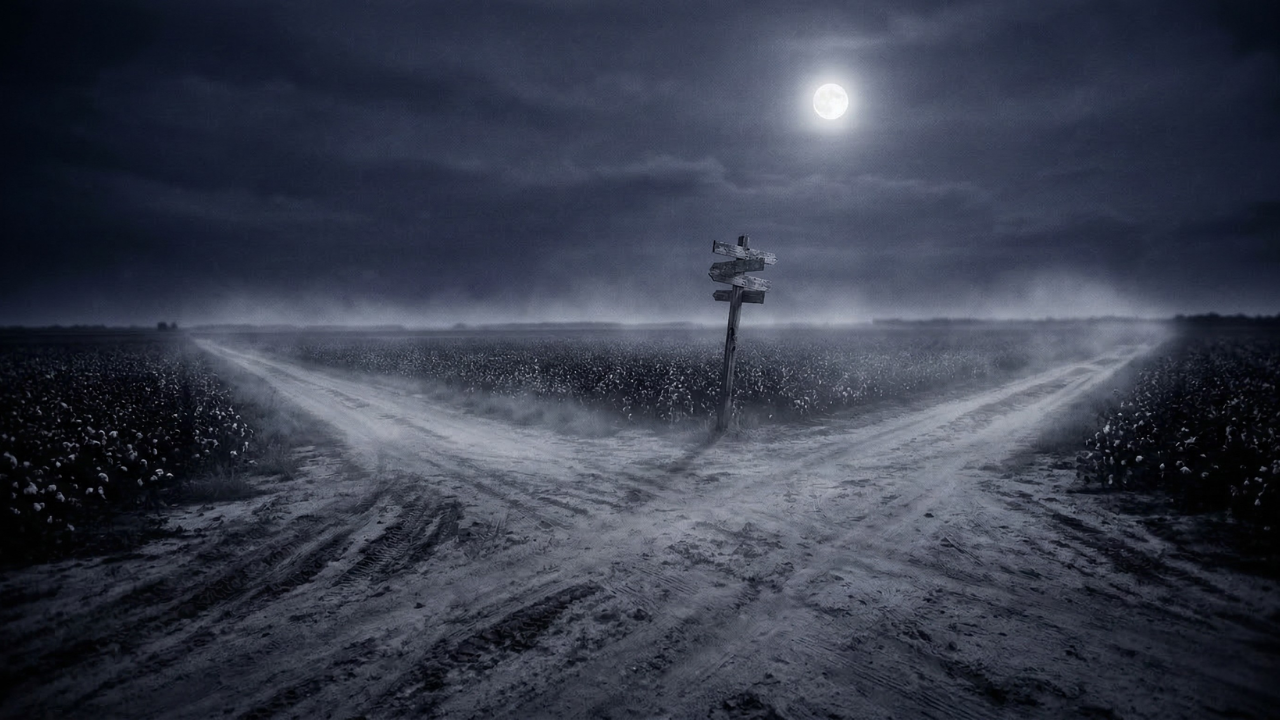
The story goes like this. Robert Johnson took his guitar to the crossroads at midnight — most often said to be the intersection of Highways 61 and 49 in Clarksdale, Mississippi — and waited. The Devil appeared, took Johnson's guitar, tuned it, played a few songs, and handed it back. In exchange for his soul, Johnson received the gift of supernatural musical ability.
It's a great story. It's almost certainly not true. But it has proven to be one of the most enduring legends in American music — and Johnson himself seemed to enjoy feeding it. Songs like Cross Road Blues, Me and the Devil Blues, and Hell Hound on My Trail painted a picture of a man pursued by dark forces, living fast and looking over his shoulder.
Whether he was a true believer or simply a brilliant self-mythologizer, the effect was the same. Robert Johnson became larger than life before his life was even over.
29 Songs That Changed Everything
Johnson recorded everything he left us in just two sessions — San Antonio in 1936 and Dallas in 1937. Twenty-nine songs. Some were recorded in hotel rooms, others in makeshift studio setups. The sound quality by modern standards is rough, distant, like music coming through a wall from another era.
And yet those recordings crackle with something undeniable. His guitar work is extraordinary — he played bass lines, rhythm, and lead simultaneously in a way that made him sound like two or three musicians at once. His lyrics were vivid, poetic, and deeply unsettling. He sang about love and loss and the road and death with a directness that felt almost dangerous.
Songs like Sweet Home Chicago, Love in Vain, and Terraplane Blues became standards that have been covered thousands of times by everyone from Muddy Waters and Elmore James to The Rolling Stones, Eric Clapton, and Led Zeppelin.
When Keith Richards first heard Robert Johnson he reportedly asked who the second guitarist was. There wasn't one.
Gone at 27
Johnson died in August 1938 near Greenwood, Mississippi. He was 27 years old. The cause of death is still debated — some say strychnine poisoning slipped into his whiskey by a jealous husband, others point to other causes. There was no death certificate filed for weeks. Like so much of his life, the ending is shrouded in mystery.
What isn't a mystery is what he left behind. Those 29 songs have influenced virtually every major figure in blues and rock history. They have been studied, dissected, covered, and celebrated for nearly ninety years. They show no signs of fading.
Robert Johnson may or may not have met the Devil at the crossroads. But he made a deal with something that night — with the music itself, perhaps — and the music has been paying it back ever since.